forked from cores/microwatt
You cannot select more than 25 topics
Topics must start with a letter or number, can include dashes ('-') and can be up to 35 characters long.
 Paul Mackerras
25b9450475
Paul Mackerras
25b9450475
This moves the negation of negative operands for signed divide and modulus operations out of the decode2 stage and into the divider. If either of the operands for a signed divide or modulus operation is negative, the divider now takes an extra cycle to negate the operands that are negative. The interface to the divider now has an 'is_signed' signal rather than a 'neg_result' signal, and the dividend and divisor can be negative, so divider_tb had to be updated for the new interface. The reason for doing this is that one of the worst timing violations on the Arty A7-100 at 100MHz involved the carry chain in the adders that did the negation of the dividend and divisor in the decode stage. Moving the negations to a separate cycle fixes that and also seems to reduce the total number of slice LUTs used. Signed-off-by: Paul Mackerras <paulus@ozlabs.org> |
7 years ago | |
|---|---|---|
| fpga | 7 years ago | |
| hello_world | ||
| scripts | 7 years ago | |
| sim-unisim | 7 years ago | |
| tests | ||
| .gitignore | ||
| .travis.yml | ||
| LICENSE | ||
| Makefile | 7 years ago | |
| README.md | 7 years ago | |
| common.vhdl | 7 years ago | |
| core.vhdl | 7 years ago | |
| core_debug.vhdl | 7 years ago | |
| core_tb.vhdl | 7 years ago | |
| cr_file.vhdl | ||
| crhelpers.vhdl | 7 years ago | |
| decode1.vhdl | 7 years ago | |
| decode2.vhdl | 7 years ago | |
| decode_types.vhdl | 7 years ago | |
| divider.vhdl | 7 years ago | |
| divider_tb.vhdl | 7 years ago | |
| dmi_dtm_dummy.vhdl | 7 years ago | |
| dmi_dtm_tb.vhdl | 7 years ago | |
| dmi_dtm_xilinx.vhdl | 7 years ago | |
| execute1.vhdl | 7 years ago | |
| execute2.vhdl | 7 years ago | |
| fetch1.vhdl | 7 years ago | |
| fetch2.vhdl | 7 years ago | |
| glibc_random.vhdl | 7 years ago | |
| glibc_random_helpers.vhdl | 7 years ago | |
| helpers.vhdl | 7 years ago | |
| icache.vhdl | ||
| icache_tb.vhdl | ||
| insn_helpers.vhdl | 7 years ago | |
| loadstore1.vhdl | 7 years ago | |
| loadstore2.vhdl | 7 years ago | |
| microwatt.core | 7 years ago | |
| multiply.vhdl | ||
| multiply_tb.vhdl | 7 years ago | |
| ppc_fx_insns.vhdl | ||
| register_file.vhdl | ||
| sim_console.vhdl | 7 years ago | |
| sim_console_c.c | ||
| sim_jtag.vhdl | 7 years ago | |
| sim_jtag_socket.vhdl | 7 years ago | |
| sim_jtag_socket_c.c | 7 years ago | |
| sim_uart.vhdl | ||
| simple_ram_behavioural.vhdl | 7 years ago | |
| simple_ram_behavioural_helpers.vhdl | 7 years ago | |
| simple_ram_behavioural_helpers_c.c | ||
| simple_ram_behavioural_tb.bin | ||
| simple_ram_behavioural_tb.vhdl | 7 years ago | |
| soc.vhdl | 7 years ago | |
| wishbone_arbiter.vhdl | 7 years ago | |
| wishbone_debug_master.vhdl | 7 years ago | |
| wishbone_types.vhdl | 7 years ago | |
| writeback.vhdl | 7 years ago | |
README.md
Microwatt
A tiny Open POWER ISA softcore written in VHDL 2008. It aims to be simple and easy to understand.
Simulation using ghdl
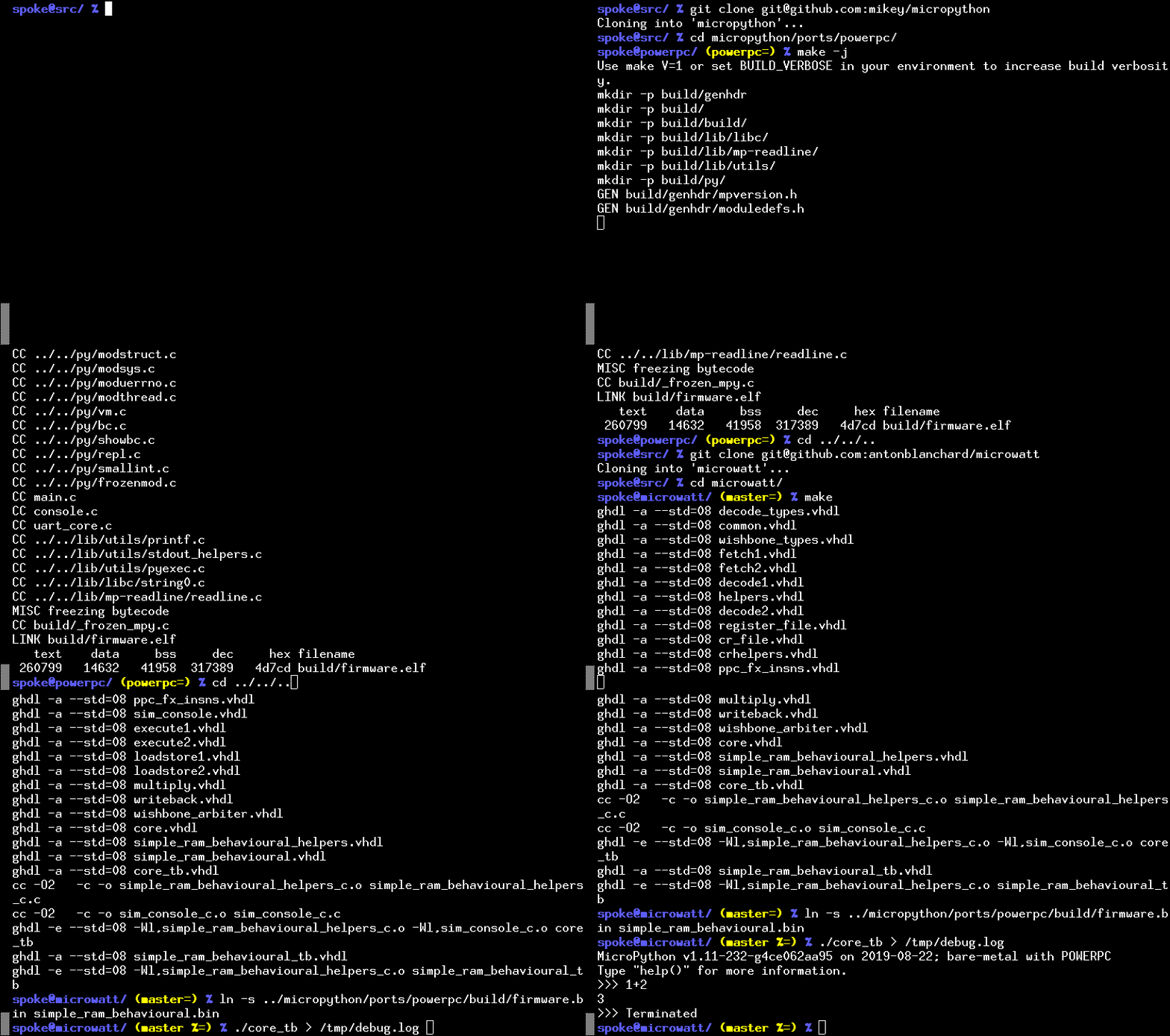
- Build micropython. If you aren't building on a ppc64le box you will need a cross compiler. If it isn't available on your distro grab the powerpc64le-power8 toolchain from https://toolchains.bootlin.com
git clone https://github.com/mikey/micropython
cd micropython
git checkout powerpc
cd ports/powerpc
make -j$(nproc)
cd ../../../
- Microwatt uses ghdl for simulation. Either install this from your distro or build it. Next build microwatt:
git clone https://github.com/antonblanchard/microwatt
cd microwatt
make
- Link in the micropython image:
ln -s ../micropython/ports/powerpc/build/firmware.bin simple_ram_behavioural.bin
- Now run microwatt, sending debug output to /dev/null:
./core_tb > /dev/null
Synthesis on Xilinx FPGAs using Vivado
-
Install Vivado (I'm using the free 2019.1 webpack edition).
-
Setup Vivado paths:
source /opt/Xilinx/Vivado/2019.1/settings64.sh
- Install FuseSoC:
pip3 install --user -U fusesoc
- Create a working directory and point FuseSoC at microwatt:
mkdir microwatt-fusesoc
cd microwatt-fusesoc
fusesoc library add microwatt /path/to/microwatt/
- Build using FuseSoC. For hello world (Replace nexys_video with your FPGA board):
fusesoc run --target=nexys_video microwatt --memory_size=8192 --ram_init_file=/path/to/microwatt/fpga/hello_world.hex
- To build micropython (currently requires 1MB of BRAM eg an Artix-7 A200):
fusesoc run --target=nexys_video microwatt
Testing
- A simple test suite containing random execution test cases and a couple of micropython test cases can be run with:
make -j$(nproc) check
Issues
This is functional, but very simple. We still have quite a lot to do:
- There are a few instructions still to be implemented
- Need to add caches and bypassing (in progress)
- Need to add supervisor state (in progress)